
Project Overview
Pulsatrix is an open-source (MIT) deep learning library written in C++ and built around one rule: explainability is part of what it means to be a layer. Every module has to implement propagate_relevance(). It's a pure virtual function on the Module base class, so a layer without Layer-wise Relevance Propagation (LRP) won't compile.
On top of that core sit post-hoc explainers, mechanistic interpretability tools, a reinforcement learning stack, neuro-symbolic components and a native visualization layer. All of it runs on CPU, NVIDIA (CUDA) and AMD (HIP/ROCm) GPUs.
Technical Architecture
Core
Tensorwith an autograd computation graph, SGD and Adam, and the standard losses.- A
DeviceBackendinterface with CPU, CUDA and HIP implementations. The two GPU backends compile from a single shared kernel source. - 29 modules, including Linear, Conv2D, pooling, normalization layers, RNN/LSTM/GRU, multi-head attention, transformer blocks, Mamba, RetNet, RWKV and fuzzy-logic operators.
Explainability
- LRP in every layer:
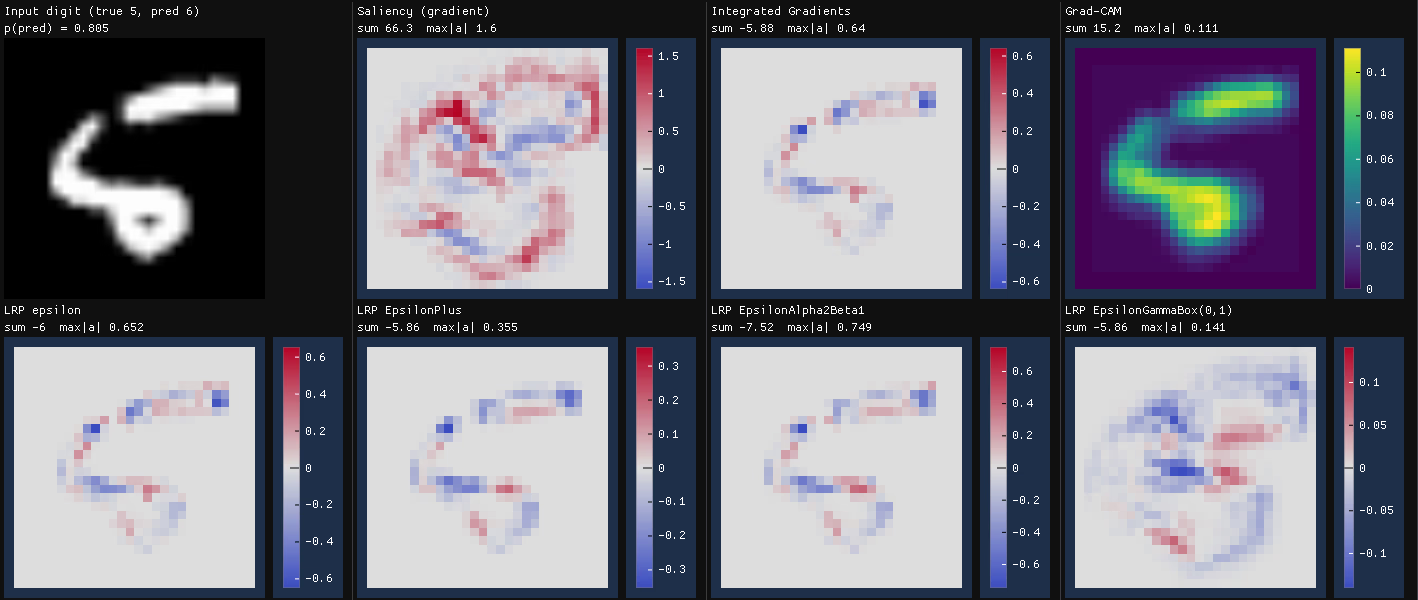
- Linear and Conv2D support the ε, γ, α-β (including z⁺) and ZBox rules, assignable per layer through Zennit-style composites.
- Recurrent layers use Arras et al.'s rules, attention uses AttnLRP and Mamba uses MambaLRP.
- Whole-model API:
LRP::explain()runs the forward pass, seeds relevance at a target class (or a target against a contrast class) and returns an attribution. It's also available from Python. - Post-hoc explainers: KernelSHAP, LIME, Partial Dependence, Saliency, Integrated Gradients and Grad-CAM.
- Mechanistic interpretability: activation patching, linear probes with negative controls, sparse autoencoders and circuit graphs.
Beyond Supervised Learning
- Reinforcement learning: DQN/Double DQN, REINFORCE, A2C, PPO, SAC and GFlowNets.
- Neuro-symbolic: fuzzy-logic modules with satisfaction losses, plus a Datalog engine whose proofs can themselves be explained with LRP, through to the input of a neural predicate.
Verification
The library was built with an AI coding agent following a test-first loop, so verification was treated as part of the deliverable rather than an afterthought:
- External LRP references: whole-model LRP matches Zennit 1.0.0 (MLP and CNN, across its rule presets) and LXT 2.1 AttnLRP (attention and transformer blocks) to within 1e-5. The pinned environment that generates the reference values ships with the repo.
- Captum references: Saliency, Integrated Gradients and Grad-CAM are checked against values generated with Captum.
- Conservation tests: relevance must add up across each layer. Where it provably doesn't (attention), the gap is measured and reported instead of hidden.
- GPU vs CPU equivalence: every module's forward pass, backward pass and LRP on the GPU is compared with the CPU. Full training runs (MLP, CNN, recurrent, state-space and DQN) must end with the same weights on both.
- Around 2,000 tests pass on CPU, NVIDIA and AMD hardware.
Key Results
- A small CNN trained on real MNIST reaches 96% held-out accuracy in about a minute on a CPU, and its predictions are explained pixel by pixel. That includes a confidently wrong one, which accuracy alone would never reveal.
- PPO and Double DQN agents learn CartPole from scratch in about a second each on a CPU.
- The full library compiles to a 2.8 MB static library with no Python runtime, for deployments where the explanations need to travel with the model.
Future Enhancements
- Explanations for RL agents ("why did the agent take this action?") built on the same LRP tooling.
- Broader external LRP validation, covering recurrent and state-space rules.
- Automated circuit discovery for the mechanistic interpretability tools.